
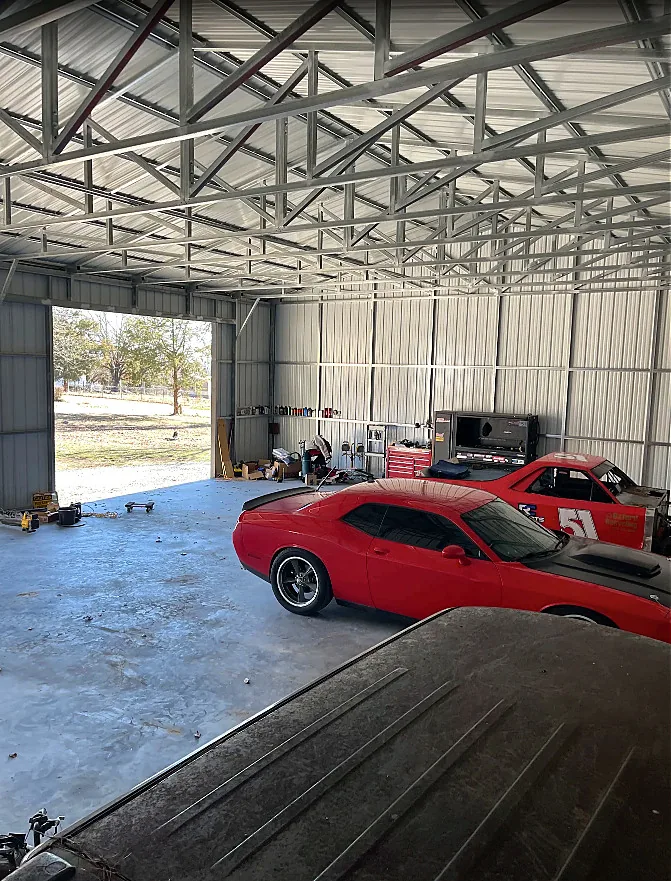
When you compare metal building quotes, one line item shows up again and again: 12 gauge or 14 gauge framing. It sounds technical, but the idea is simple, and it affects how your building stands up to wind, snow and years of use.
What gauge means
Gauge is a measure of steel thickness, and the scale runs backwards: a lower number is thicker steel. Standard gauge thicknesses are about 0.105 inches for 12 gauge and about 0.075 inches for 14 gauge, so 12 gauge is roughly 40 percent thicker.
Thicker tubing is stiffer and carries more load before it bends. That is why 12 gauge is often described as the heavy-duty option.
Frame gauge vs panel gauge
Two different parts of the building have a gauge, and they are not the same thing:
- Frame gauge (12 or 14) describes the structural tubing: the legs, rafters and bracing.
- Panel gauge describes the roof and wall sheets, which are much thinner. Common panel gauges are around 29 or 26.
If a quote says "12 gauge," ask whether it means the frame, the panels, or both.
Where 12 gauge makes sense
A heavier frame is usually worth considering when:
- You live where high winds or heavy snow are normal. Greater strength helps with the design loads for your location.
- The building is wider, taller or longer, so the frame spans more distance.
- You plan to hang a lift, add a loft or a mezzanine, or hold heavy equipment.
- You want a longer service life and are willing to pay more upfront.
- You are storing expensive items, such as vehicles, RVs or machinery.
Where 14 gauge is a good fit
14 gauge framing can be the right call for:
- Smaller carports and one-car garages
- Mild climates with moderate wind and snow
- Lighter storage and budget-focused projects
A 14 gauge frame can still be fully certified for your area. Gauge is only one part of the design. Spacing, bracing, anchoring and roof style all matter too.
The real rule: certification beats gauge
It is tempting to treat gauge as a score where higher always wins. The better question is: is this building engineered for the wind and snow at my address? A certified 14 gauge building can outperform an unengineered 12 gauge one. Look for engineering tied to your location, which we explain in permits and engineering.
How gauge affects price
Heavier steel costs more, and it also changes shipping weight. In most quotes you will see the price difference grow with building size. Weigh that against your climate, how you will use the building and how long you plan to own it. For the full list of price factors, read how much a metal garage costs.
Quick decision guide
| Your situation | Often a good fit |
|---|---|
| Small carport, mild weather | 14 gauge |
| Two-car garage, average conditions | 14 or 12 gauge, depending on certification |
| High wind, coastal or heavy snow | 12 gauge, certified for your address |
| Workshop with a lift or loft | 12 gauge |
| Commercial or large span | Engineered frame, confirmed by your specialist |
FAQ
Is 12 gauge always better than 14 gauge?
Thicker steel is stronger, but it is not automatically the right choice. A building must be engineered for your location. Gauge is one input.
Does gauge affect the warranty?
Warranty terms depend on the manufacturer and the building. Review our warranty page and ask your specialist for the details on the building you choose.
Can I upgrade to 12 gauge later?
No. Gauge is part of the frame, so decide before you order.
What gauge are the roof and wall panels?
Panels are a separate, thinner steel. Your quote should list panel gauge and frame gauge separately.
Ready to compare? Get a price for your ZIP and ask for frame and panel gauge in writing.